What others says about me....
"The sober and simple environment, where the packing material stacked in a corner is visible, reflects a constant coming and going of the artwork and its creator. Likewise, one can observe the tools the artist uses to create her paintings: an easel, a bookshelf with a few reference books, and her red sneakers/amulets that she uses as part of a ritual when painting. The works on display here are abundant, reflecting what is seen on the walls of the artist's studio."
"El entorno sobrio y sencillo, donde el material de empaque apilado en una esquina es visible, evidencia un constante ir y venir de la obra y su artífice. Asimismo, se pueden observar los instrumentos que la artista utiliza para crear sus pinturas, un caballete, un librero con unos cuantos libros de referencia y sus tenis/amuletos de color rojo que usa como parte de un ritual cuando pinta. La obra aquí expuesta es abundante, reflejo de lo que se observa en las paredes del estudio de la artista."
Dolores Mercado. Adláteres and the unexpected Journey, works by Carmen Chami. Aldama Fine Art, National Museum of Mexican Art.
Catalogue 2020
The Evident and the Hidden in the Paintings of Carmen Chami
"At first glance, Carmen Chami's painting proposal fits within a realistic-symbolic trend. This would be the immediate assessment of conventional critics, and indeed, this is how her works are received and appropriated by the art system and by viewers: encrypted narratives with contemporary, personal, and universal elements alike, available for material-formal perception and iconographic decoding. Considering all of this in terms of the work as an outcome, Carmen Chami's approach aligns with the production of numerous painters who subscribe to the premises of current realism. However, from my point of view, something very interesting to highlight about the significance of Carmen Chami's proposal—besides the iconic charge ultimately communicated in the narrative plots she develops—is what results from a thorough examination of her formative stages as an artist, which are also the variables she engages in the visual production process of her paintings."
Lo evidente y lo oculto en la pintura de Carmen Chami
"A primera vista, la propuesta de pintura de Carmen Chami está ubicada dentro de una tendencia realista-simbólica. Ésa sería la valoración inmediata de la crítica convencional y, en efecto, así es como sus obras son recibidas y apropiadas por el sistema del arte y por los espectadores: narrativas cifradas con elementos contemporáneos, personales y universalistas por igual, disponibles para la percepción matérico-formal y para el desciframiento iconográfico. Considerando todo esto en términos de la obra como resultado, lo de Carmen Chami coincide con la producción de numerosos pintores que suscriben las premisas de los realismos actuales. Sin embargo, desde mi punto de vista, algo muy interesante para visibilizar la relevancia de la propuesta de Carmen Chami, además de la carga icónica final comunicada en las tramas narrativas que elabora, es lo que resulta del examen a fondo de sus fases de formación como artista, y que también son las variables que ella pone en juego en el proceso de producción visual de sus cuadros.
Eric Castillo. Adláteres and the unexpected Journey, works by Carmen Chami. Aldama Fine Art, National Museum of Mexican Art.
Catalogue 2020
Carmen Chami and the Quotidian I
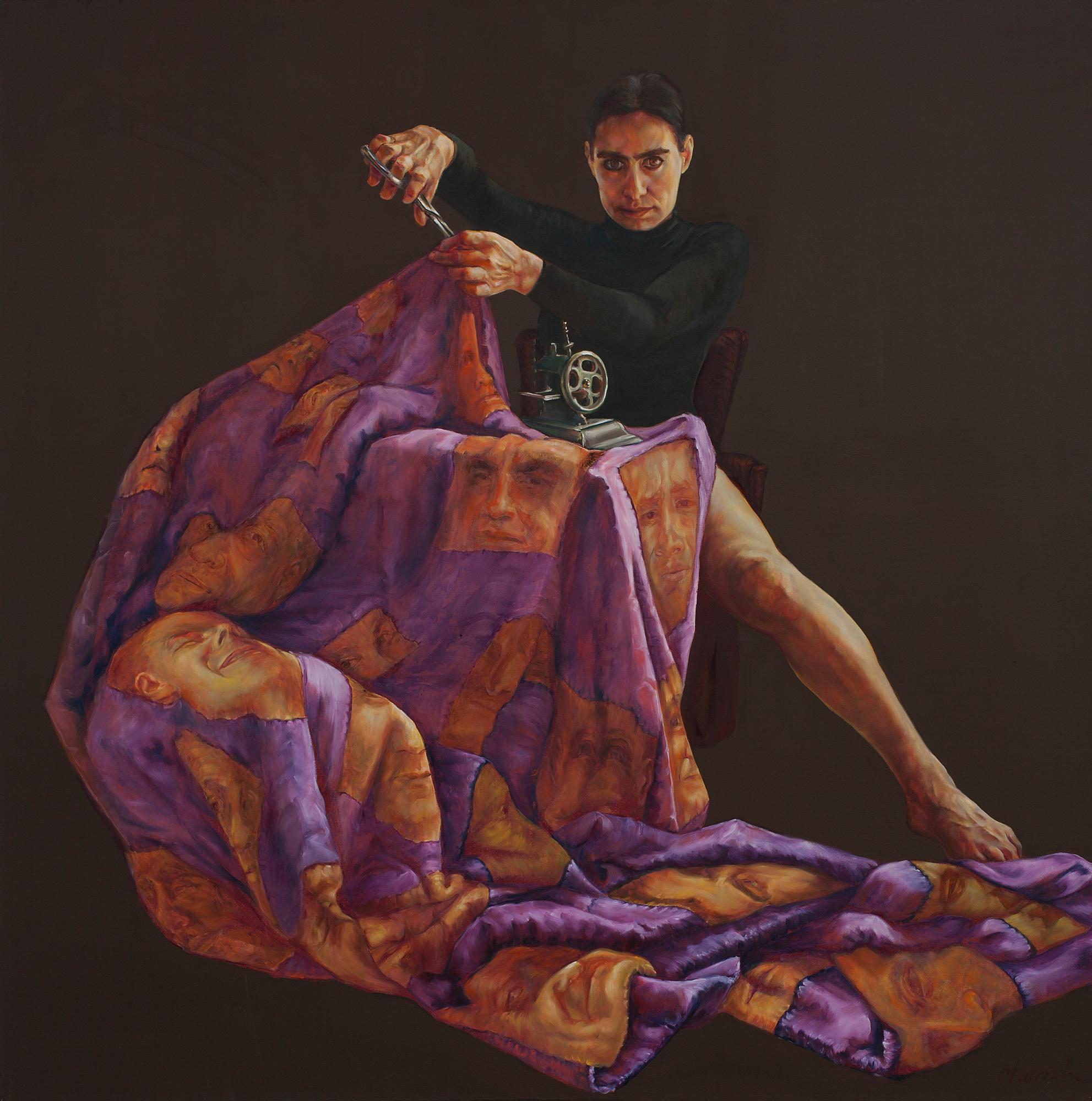
"The artist use the self-portrait, creation is contained in the deformed and falsified universe that returns from the mirror. Carmen Chami stopped looking far away and beyond to look into the mirror, she is both the research and subject, she is observed to dissect each of her traits, gestures, she is desmembered to be reconfigured as another being, into a character who incarnates an unfinished story. She paints two people, one real, authentic, who is observed and reproduced in all of its carnality and the other she invents, her face in her own mask, it is revealed through a fiction of itself, of a lie.It is Penelope, Lady Macbeth, she is a killer or a seductress, Carmen finds herself in all of them, she sublimates her weakness, she exalts her darkness. Paintings plays the satrring role, that scenario allows her to exist, seating behind an antique sewing machine, it brings together an enourmous canvas of faces; she raises a fragment and begins to cut it with scissors. What life does Carmen cut?. What face does she wish forget? Why did she sew it together to then tear it apart? [...]Her command over the knowledge of the human figure, of its tonalities, densities, movements, gives reality to Carmen's incarnation on their other women,it might seem that Carmen paints herself, and that permits her to flee but that it not the case, she enters her own inner world with utter abandon, she is saturated with herself to paint herself again."
Avelina Lésper. Quotidian Pleasures.Aldama Fine Art/Ediciones el Camino
Book 2018
"RECOMMENDED
In an exhibition with work by male and female artists, the most formidable warriors in this exhibit are some of the women artists themselves. Carmen Chami immerses another artist, Aya Watanabe, in the spatial dynamics of historic Japanese screen painting as well as presenting the portrait subject’s unique personality. It’s done so well you might guess that Chami specializes in a Japanese style, but if you visit her website, you won’t find anything else like it. You will, however, discover her Mannerist self-portrait as Judith with the severed head of Holofernes between her legs. She’s an incredibly effective narrative painter who can work the expressive details of a human face into a strong design. [...]".
Chris Miller, "Wonder Woman: A review of Woman as Warrior at the Zhou B Art Center" Art Newcity. Chicago.
"Chami’s superb portrait entitled Aya Watanabe shows a beautiful, strongminded Japanese woman who, despite coming from a sociocultural tradition of female submission, broke the rules early on to carve out her own destiny. Chami visually captures Watanabe’s courage, strength, and sense of self-reliance, essential characteristics to take the road less traveled. The traditional Japanese setting is a reminder that we never quite break with our past, no matter how far we have come. The use of fine realism in combination with strong graphic elements makes this portrait a joy to the eye."
Lorena Kloosterboer, Poets and Artist. Woman as Warrior. Zhou B Art Center Chicago.
"In her work, extraordinary craftsmanship is evident—both in the precision of her drawings and in her profound understanding of physical and emotional anatomy, which echoes the masters of old. Carmen breathes life into her characters; we don’t just see them, we feel their presence. This ability to infuse vitality into her work, to use brushstrokes not merely as academic tools but as vessels of life itself, is perhaps the most powerful aspect of her art. Amidst the technological advances shaping visual arts today, her commitment to painting stands as a striking testament to the enduring depth of expression in our time."
"En sus obras de extraordinario oficio, se aprecia un dibujo riguroso, un conocimiento de anatomía física y emocional que nos refiere a los maestros de antaño. Carmen infunde fuerza vital a sus personajes, a quienes además de verlos, sentimos su presencia. Considero que este es uno de los atributos más poderosos de su trabajo, emplear la pincelada no como herramienta académica sino con el criterio de infundir la vitalidad que implica el objetivo que se ha planteado. Enmedio de la tecnología que actualmente se aplica a las artes visuales sobresale esta apuesta por la pintura que enriquece la diversidad expresiva de nuestro tiempo. [...)"
Lupina Lara Elizondo, Compendio de Creadores Mexicanos, Tomo III. 2016
"Her paintings are narratives born from both personal theory and lived experience. The five images presented here are self-portraits—what better model for introspection than the self, transferred to the canvas? As a symbol, the artist uses herself to make her physical and ideological stance on reality undeniable. There is no concession to idealization in her portrayal of multi-tonal flesh or the expressive forms of faces and bodies, which remain raw and unembellished."
"[...} Pintura de narrativas, parte de sus propios intereses teóricos y vivenciales; las cinco imágenes aquí mostradas son autorretratos, ¿qué mejor modelo para la introspección que el propio yo transferido al lienzo? Dispuesta como símbolo, la artista se sirve de sí misma para hacer patente su postura, física e ideológica, ante la realidad, sin concesión en la representación de las carnaciones multitonales o en la expresividad de las fisionomías y cuerpos, que no buscan idealización alguna. [..}"
Sofía Neri Fajardo, Evocaciones 2016. Catálogo Aldama Fine Art
"When I asked myself what Carmen Chami truly wanted to speak about, it became clear—she speaks of the everyday. But not just its surface, she delves into the psyche of the mundane."
"Al preguntarme de qué quería hablar particularmente Carmen Chami, vi que Carmen Chami tiene muy claro de qué quería hablar, y sigue hablando hoy en día, es de la cotidianidad. Pero no plasmar cosas cotidianas, sino la psique de lo cotidiano. [...}"
Avelina Lésper, La poesía vista por el Arte. 2015
"Carmen Chami is a juggler of paint, capturing the gestures of effort in precise, attentive actions. She explores subtle nuances, textures, and light in harmonious tones, probing the dilemmas etched in faces. With delicate attention, she reveals the wear and rust of time's passage—its marks on things, bodies, and the quiet spaces between elegance, the unknown, and the miserable. Her work gives voice to beings caught in tension, forced into inevitable actions—whether they lie still or carry out decisive movements.
Her steady will guides her through painting as an expressive medium, where, through deep knowledge of materials and techniques, she weaves traditional methods with her personal and artistic explorations—forever navigating the tensions between her academic roots, the realities of life, and her critique of human interactions within it."
"Carmen Chami es malabarista del pintar para hallar gestos de esfuerzos en acciones exactas y atentas. Explora diversos matices, texturas y luces en tonos similares en los elementos de una escena. Crea para indagar los dilemas de los rostros. Con minucia trata deterioros, herrumbres, pasos del tiempo y sus huellas en las cosas, en los cuerpos, y en la espera diferenciada entre lo elegante, lo inédito o lo miserable. Pintando da sentido a seres crispados, orillados a acciones ineludibles: que simplemente yacen o que realizan acciones contundentes.
La artista ha ejercido una voluntad firme para transitar por la pintura como medio expresivo, explorando —gracias a su conocimiento de materiales, herramientas y procedimientos— las tradiciones técnicas de la disciplina articuladas en discursos de sus propias búsquedas actuales, personales y artísticas, no exentas de tensiones entre su bagaje académico, la vida misma y la crítica a las interacciones humanas en ella [...}"
Eugenia Macías, Carmen Chami: oficios pictóricos como recursos reflexivos y vitales. Catálogo Estratagemas. Aldama Fine Art. 2012